 |
Gaia-ECS v0.9.3
A simple and powerful entity component system
|
|
Gaia-ECS v0.9.3
A simple and powerful entity component system
|




Gaia-ECS is a fast, ergonomic C++17 ECS framework designed to be the option you can actually learn in an afternoon without reading a manual the size of a novel. You get complex queries with relationship traversal, per-component AoS/SoA layouts, integrated serialization, and multithreading with job dependencies — all behind an API that stays out of your way.
Highlights:
Quality:
NOTE: Due to its extensive use of acceleration structures and caching, this library is not a good fit for hardware with very limited memory resources (measured in MiBs or less). Micro-controllers, retro gaming consoles, and similar platforms should consider alternative solutions.
Entity-Component-System (ECS) is an architectural pattern that organizes code around data rather than objects, following the principle of composition over inheritance.
Instead of modeling your program around real-world objects (car, house, human), you think in terms of the data needed to achieve a result. When moving something from A to B you don't care if it's a car or a plane — you only care about its position and velocity. This makes code easier to maintain, extend, and reason about, while also being more naturally suited to how modern hardware works.
Think of ECS as a database engine without ACID constraints — optimized for latency and throughput beyond what a general-purpose database could achieve, at the cost of data safety guarantees. Queries over entities are fast by design, and data locality is a first-class concern rather than an afterthought.
The three building blocks are:
A vehicle is any entity with Position and Velocity. Add Driving and it's a car. Add Flying and it's a plane. The movement systems only care about the components they need — nothing else.
Gaia-ECS is a hybrid ECS combining archetype-based storage with optional out-of-line component payload storage. Unique combinations of components are grouped into archetypes — think of them as database tables where components are columns and entities are rows.
Each archetype is made up of chunks: fixed-size blocks of memory sized so that a full chunk fits in L1 cache on most CPUs. Components of the same type are laid out linearly within a chunk, minimizing heap allocations and keeping iteration cache-friendly.
The main strengths of this layout are fast iteration, predictable memory usage, and natural parallelism. The tradeoff is that adding or removing fragmenting ids requires moving data between archetypes — mitigated here by an archetype graph and support for batched component changes.
Gaia-ECS also supports selected component data living outside chunk columns when a different tradeoff is needed. That keeps the main archetype path optimized for dense iteration while still allowing more dynamic, optional, or less cache-sensitive data to use a different storage path.
Queries are compiled into bytecode and executed by an internal virtual machine, ensuring only the complexity your query actually needs is paid for.
Components are themselves entities with a Component tag attached. Treating components as first-class entities is what enables relationships and keeps the overall design orthogonal — the same mechanisms that handle entities handle components, without special cases.
The entire project is implemented inside gaia namespace. It is further split into multiple sub-projects each with a separate namespaces.
core - core functionality, use by all other parts of the codemem - memory-related operations, memory allocatorscnt - data containersmeta - reflection frameworkser - serialization frameworkmt - multithreading frameworkecs - the ECS part of the projectThe project has a dedicated external section that contains 3rd-party code. At present, it only includes a modified version of the robin-hood hash-map.
The entire framework is placed in a namespace called gaia. The ECS part of the library is found under gaia::ecs namespace.
In the code examples below we will assume we are inside gaia namespace.
Entity a unique "thing" in ecs::World. Creating an entity at runtime is as easy as calling World::add. Deleting is done via World::del. Once deleted, entity is no longer valid and if used with some APIs it is going to trigger a debug-mode assert. Verifying that an entity is valid can be done by calling World::valid.
It is also possible to attach entities to entities. This effectively means you are able to create your own components/tags at runtime.
Each entity can be assigned a unique name. This is useful for debugging or entity lookup when entity id is not present for any reason.
If you already have a dedicated string storage it would be a waste to duplicate the memory. In this case you can use World::name_raw to name entities. It does NOT copy and does NOT store the string internally which means you are responsible for its lifetime. The pointer, contents, and length must stay stable while the raw name is registered. Otherwise, any time your storage tries to move or rewrite the string you have to unset the name before it happens and set it anew after the change is done.
Hierarchical name lookup is also possible.
Character '.' (dot) is used as a separator. Therefore, dots can not be used inside entity names.
World::name gives an entity its normal world name. World::alias gives an entity one extra lookup name. World::get is the normal lookup entry point. It first tries ordinary entity names, including hierarchical paths such as gameplay.render, and then falls back to component lookup rules when the string does not name an entity directly.
Names and aliases are both unique lookup keys. A name is the entity’s canonical world name and participates in hierarchy. An alias is an extra flat lookup key that does not change the entity’s place in that hierarchy.
Components add a few extra naming helpers because they need more than one identity. A component symbol is the stable C++ identity, such as gameplay_render::Position. A component path is the scoped lookup name, such as gameplay.render.Position. A display name is the prettier label you would prefer to show in logs and tools.
Most code should just use World::get. Use a name when the entity should live in the normal world hierarchy. Use an alias when you want one extra flat lookup key without changing that hierarchy. Use a symbol when you need a stable component identity, for example in semantic JSON. Use a path when you want to refer to a component by its place in the ECS scope hierarchy. If a name does not resolve the way you expect, World::resolve(out, name) collects every entity the world naming rules can see for that string.
World::scope(scope) sets the current component scope and returns the previous one. World::scope(scope, func) does the same thing for the duration of one callable and restores the old scope afterwards.
World::lookup_path(scopes) sets an ordered list of lookup scopes used for unqualified component lookup. Each scope is searched like a temporary component scope: the scope first, then its parents. World::lookup_path() returns the current list.
The scope entity and its ChildOf ancestors should have names, because Gaia-ECS builds the scoped path from that entity hierarchy. New components registered while a scope is active use that scope to build their default path name.
For example, registering Position while the current component scope is the entity path gameplay.render gives the component the path name gameplay.render.Position.
Unqualified component lookup checks the active scope first, then walks up parent scopes, then searches each lookup-path scope in order while also walking up its parents, then falls back to global exact symbol lookup, global path lookup, global unique short-symbol lookup, and finally alias lookup. That means a lookup from gameplay.render can still find gameplay.Position when there is no closer match in gameplay.render, a lookup path such as {tools, render} can prefer gameplay.tools.Device before falling back to gameplay.Device, and a bare "Position" can resolve globally when that short symbol is unique.
String queries follow the same rules, but they capture the active scope and lookup path when the query expression is parsed. In practice that means w.scope(render, [&] { q.add("Position"); }); or w.lookup_path(scopes); q.add("Position"); resolve Position while add(...) runs, store the resulting component id in the query, and will not be rewritten later if the scope or component naming metadata changes. If a query uses a bare short name such as "Position", that global fallback only works when the short symbol is unique.
Scoped component registration looks like this:
If you prefer creating named scopes directly from strings, World::module(module_path) creates or reuses the named ChildOf chain and returns the deepest scope entity. You can then pass that entity to World::scope(...) explicitly when you want to activate it.
World::module(...) only creates or finds the scope hierarchy. World::scope(...) is the step that makes registration and relative lookup happen inside that scope.
By default, components and relationships are fragmenting. Adding or removing them changes the entity archetype, which is great for structural queries and dense iteration, but it also means more archetype churn and more fragmentation when the data is highly dynamic.
If this is undesired, there is also an option to use out-of-line storage and optional non-fragmenting membership. The two traits are:
ecs::Sparseecs::DontFragmentTo use a non-fragmenting sparse component:
That gives three practical outcomes:
Sparse:DontFragment:Sparse plus "do not participate in archetype identity"Rule of thumb:
Sparse when the payload should live out-of-line but the component should still participate in structural matchingDontFragment for cooldowns, temporary status effects, optional markers, editor/runtime state, and other frequently changing dataPosition or Velocity which benfit greatly of sequential access, unless profiling clearly justifies it>NOTE:
SoA components do not support out-of-line storage and they stay chunk-backed. ecs::Sparse applies only to plain AoS generic components.
>NOTE:
Changing the storage mode is only supported before the component has instances attached to entities.
>NOTE:
ecs::Sparse and ecs::DontFragment are sticky component traits. Once set on a component entity, removing the relation later does not revert the storage or fragmentation behavior. ecs::DontFragment also implies sparse out-of-line storage, so adding both traits is redundant.
Whether or not a certain component is associated with an entity can be checked in two different ways. Either via an instance of a World object or by the means of Iter which can be acquired when running queries.
Providing entities is supported as well.
Components can be created using World::add<T> This function returns a descriptor of the object which is created and stored in the component cache. Each component is assigned one entity to uniquely identify it. You do not have to do this yourself, the framework performs this operation automatically behind the scenes any time you call some compile-time API where you interact with your structure. However, you can use this API to quickly fetch the component's entity if necessary.
Because components are entities as well, adding them is very similar to what we have seen previously.
This also means the code above could be rewritten as following:
When adding components following restrictions apply:
ecs::DontFragment and stored outside archetypes do not consume these slots. If you need more archetype-resident ids you can merge some of your components, or rethink the strategy because too many fragmenting ids usually implies design issues (e.g. object-oriented thinking or mirroring real-life abstractions too directly in ECS).ecs::Sparse or ecs::DontFragment, register it explicitly first and then apply the trait to the component entity. Implicit registration can also be disabled entirely with GAIA_ECS_AUTO_COMPONENT_REGISTRATION.It is possible to register add/del/set hooks for components. When a given component is added to an entity, deleted from it, or the value is set the hook triggers. This comes handy for debugging, or when specific logic is needed for a given component. Component hooks are unique. Each component can have at most one add hook, and one delete hook.
Hooks can easily be removed:
It is also possible to set up a "set" hook. For explicit setter APIs such as w.set<T>(e) = ... and w.acc_mut(e).set<T>(...), the hook runs after the new value has been written back.
Unlike add and del hooks, set hooks will not tell you what entity the hook triggered for. This is because any write access is done for the entire chunk, not just one of its entities. If one-entity behavior is required, the best thing you can do is moving your entity to a separate archetype (e.g. by adding some unique tag component to it).
Hooks can be disabled by defining GAIA_ENABLE_HOOKS 0. Add and del hooks are controled by GAIA_ENABLE_ADD_DEL_HOOKS, set hooks by GAIA_ENABLE_SET_HOOKS. They are all enabled by default.
Observers are a mechanism that allows you to register to certain events and listen to them triggering. Similar to hooks, you can listen to add, del or set events. However, unlike hooks there can be any number of these per given component or entity.
Observers can be looked at as reactive alternative to systems. They allow different parts of the application to react to something happening immediately.
The feature can be enabled by defining GAIA_OBSERVERS_ENABLED 1, and is enabled by default.
Under the hood they use the query engine, just like systems. However, systems are meant to be used as a reqular part of the frame whereas observers are meant as a reaction to something. Their cost is less predictable, and because the event needs to be evaluated for each observer, listening to the event they can also be more costly.
Because observers are query-backed, query shaping helpers such as depth_order(...) can be used on them as well when you want cached top-down breadth-first iteration over fragmenting hierarchies like ChildOf.
Observers also expose the same query cache controls as plain queries. By default an observer keeps cached query state locally. Use scope(ecs::QueryCacheScope::Shared) only when many identical observer query shapes are rebuilt and you want them to reuse one shared cache entry. Use kind(ecs::QueryCacheKind::None) only for special cases where you explicitly do not want observer query caches.
Observer events currently mean:
OnAdd - an entity starts matching because ids were addedOnDel - an entity stops matching because ids were removedOnSet - a value of an already present component was explicitly writtenOnSet is triggered by APIs such as set<T>(entity), set<T>(entity, object), acc_mut(entity).set<T>(...), modify<T, true>(entity), and modify<T, true>(entity, object). It is not triggered by sset(...), modify<T, false>(...), or by the initial add<T>(entity, value) that creates the component.
set<T>(entity) uses a write-back proxy, so OnSet is emitted after the full expression or scope writes the final value back.
Mutable query and observer callbacks follow the same rule. When a callback writes through Position& or it.view_mut<Position>(), OnSet is emitted after the callback returns, not in the middle of the callback.
Following is an observer that generates an OnAdd event every time some entity is added Position and Velocity.
Listening to removal of entities looks similar:
Listening to value changes uses OnSet:
Adding an entity to entity means it becomes a part of a new archetype. Like mentioned previously, becoming a part of a new archetype means that all data associated with the entity needs to be moved to a new place. The more ids in the archetype the slower the move (empty components/tags are an exception because they do not carry any data). For this reason it is not advised to perform large number of separate additions / removals per frame.
Instead, when adding or removing multiple entities/components at once it is more efficient doing it via bulk operations. This way only one archetype movement is performed in total rather than one per added/removed entity.
It is also possible to manually commit all changes by calling ecs::EntityBuilder::commit. This is useful in scenarios where you have some branching and do not want to duplicate your code for both branches or simply need to add/remove components based on some complex logic.
>NOTE:
Once ecs::EntityBuilder::commit is called (either manually or internally when the builder's destructor is invoked) the contents of builder are returned to its default state.
w.set<T>(entity) returns a write-back proxy. The current value is copied out, you mutate the proxy, and the new value is written back at the end of the full expression or scope.
If you need the write to happen immediately, use acc_mut(entity).set<T>(...) instead of w.set<T>(entity). For runtime object/component entities, the immediate form is acc_mut(entity).set<T>(object, value).
When setting multiple component values at once it is more efficient doing it via chaining:
Similar to ecs::EntityBuilder::build you can also use the setter object in scenarios with complex logic.
The setter object supports the same immediate object-based form:
setter.mut<T>() and w.mut<T>(e) are silent raw write paths. If you use them and want hooks or OnSet, call w.modify<T, true>(e) after finishing the write.
The same pattern applies to object-based writes:
Use the write path that matches the behavior you want:
set<T>(entity) - writes back on scope/full-expression end and then triggers set hooks and OnSetset<T>(entity, object) - same as above for a specific runtime object/component entityacc_mut(entity).set<T>(...) - writes immediately and triggers set hooks and OnSetacc_mut(entity).set<T>(object, value) - immediate object-based write with set hooks and OnSetsset<T>(entity) / mut<T>(entity) - silent write paths, no hooks, no OnSetsset<T>(entity, object) / mut<T>(entity, object) - silent object-based write paths; pair them with modify<T, true>(entity, object) when you want set side effectsComponents up to 8 bytes (including) are returned by value. Bigger components are returned by const reference.
Both read and write operations are also accessible via views. Check the iteration sections to see how.
A copy of another entity can be easily created.
Anything attached to an entity can be easily removed using World::clear. This is useful when you need to quickly reset your entity and still want to keep your Entity's id (deleting the entity would mean that as some point it could be recycled and its id could be used by some newly created entity).
Another way to create entities is by creating many of them at once. This is more performant than creating entities one by one.
Every entity in the world is reference counted. When an entity is created, the value of this counter is 1. When ecs::World::del is called the value of this counter is decremented. When it reaches zero, the entity is deleted. However, the lifetime of entities can be extended. Calling ecs::World::del any number of times on the same entity is safe because the reference counter is decremented only on the first attempt. Any further attempts are ignored.
ecs::SafeEntity is a wrapper above ecs::Entity that makes sure that an entity stays alive until the last ecs::SafeEntity referencing the entity goes out of scope. When the wrapper is instantiated it increments the entity's reference counter by 1. When it goes out of scope it decrements the counter by 1. In terms of functionality, this is reminiscent of a C++ smart pointer, std::shared_ptr.
ecs::SafeEntity is fully compatible with ecs::Entity and can be used just like it in all scenarios.
ecs::WeakEntity is a wrapper above ecs::Entity that makes sure that when the entity it references is deleted, it automatically starts acting as ecs::EntityBad. In terms of functionality, this is reminiscent of a C++ smart pointer, std::weak_ptr.
ecs::WeakEntity is fully compatible with ecs::Entity and can be used just like it in all scenarios. As a result, you have to keep in mind that it can become invalid at any point.
Technically, ecs::WeakEntity is almost the same thing as ecs::Entity with one nuance difference. Because entity ids are recycled, in theory, ecs::Entity left lying around somewhere could end up being multiple different things over time. This is not an issue with ecs::WeakEntity because the moment the entity linked with it gets deleted, it is reset to ecs::EntityBad.
This is an edge-case scenario, unlikely to happen even, but should you ever need it ecs::WeakEntity is there to help. If you decided to change the amount of bits allocated to Entity::gen to a lower number you will increase the likelihood of double-recycling happening and increase usefulness of ecs::WeakEntity.
A more useful use case, however, would be if you need an entity identifier that gets automatically reset when the entity gets deleted without any setup necessary from your end. Certain situations can be complex and using ecs::WeakEntity just might be the one way for you to address them.
Once all entities of given archetype are deleted (and as a result all chunks in the archetypes are empty), the archetype stays alive for another 127 ticks of ecs::World::update. However, there might be cases where this behavior is insufficient. Maybe you want the archetype deleted faster, or you want to keep it around forever.
For instance, you might often end up deleting all entities of a given archetype only to create new ones seconds later. In this case, keeping the archetype around can have several performance benefits: 1) no need to recreate the archetype 2) no need to rematch queries with the archetype
Note, if the entity that changed an archetype’s lifespan moves to a new archetype, the new archetype’s lifespan will not be updated.
In case you want to affect an archetype directly without abstracting it away you can retrieve it via the entity's container returned by World::fetch() function:
For querying data you can use a Query. It can help you find all entities, components, or chunks matching a list of conditions and constraints and iterate them or return them as an array. You can also use them to quickly check if any entities satisfying your requirements exist or calculate how many of them there are.
By default, ecs::Query keeps cached query state locally in the query object. If you want identical query shapes to reuse one shared cache entry across the world, opt into QueryCacheScope::Shared.
Note, the first Query invocation of a cached query is always slower than the subsequent ones because internals of the Query need to be initialized.
More complex queries can be created by combining All, Or, Any (optional), and None:
All Query operations can be chained and it is also possible to invoke various filters multiple times with unique components:
all(...) requires the term, any(...) keeps the term optional, or_(...) creates an OR-chain that requires at least one OR term.
OR terms never duplicate matches. If an entity/archetype satisfies more than one OR term, it is still returned once. When no all(...) terms are present, chaining multiple or_(...) terms still means logical OR.
More advanced lookup settings are supported via QueryTermOptions. This includes source selection, traversal by relation (ChildOf by default), traversal filtering (trav, trav_up, trav_parent, trav_self_parent, trav_down, trav_child, trav_self_down, trav_self_child, trav_depth), and access type (read or write).
If you know a traversed source closure is small and stable, you can opt into traversed-source snapshots explicitly:
This is not recommended as a blanket default. It is most useful for read-heavy queries with small traversal closures.
Use walk(...) when you want to reorder the current query result in breadth-first dependency or traversal order. It does not change what the query matches, only the order in which the current result is visited.
walk(...) supports entity callbacks, typed callbacks, and regular ecs::Iter&. Entity and typed callbacks are the best optimized paths.
The iterator-style paths can be significantly slower on heavily reordered BFS results, because breadth-first order often splits the result into many small runs. Use only when for code that is not performance critical.
Use depth_order(...) when you want cached query iteration itself to run breadth-first top-down by relation depth for a fragmenting acyclic relation such as ChildOf or DependsOn. For hierarchy-style relations, the cached depth-ordered path only applies when the relation is still fragmenting. Use walk(...) when the relation is non-fragmenting, such as Parent, or when you want traversal to be resolved per entity instead of through cached archetype ordering.
Dynamic parameters (query variables) are supported via Var0..Var7 in the API and $name in expression queries.
You can also assign variable names explicitly (var_name), bind them (set_var), and remove bindings (clear_var, clear_vars).
Multi-variable queries are supported as well. In plain language: you can "remember" multiple entities while matching one cable (for example its device, power source, and backup device), and then apply additional checks on each remembered entity.
The same query can be expressed in string representation:
Queries can be defined using a low-level API (used internally).
QueryOpKind::Any is the optional term in the low-level API (? in string queries).
Another way to define queries is using the string notation. This allows you to define the entire query or its parts using a string composed of simple expressions. Any spaces in between modifiers and expressions are trimmed.
Supported modifiers:
, - term separator|| - QueryOpKind::Or? - QueryOpKind::Any! - QueryOpKind::Not& - read-write access modifier (QueryAccess::Write)e - entity value(rel,tgt) - relationship pair, a wildcard character in either rel or tgt is translated into All$name - query variableId(src) - source lookup, where src can be a variable or $this for the default sourceUncached query is a special kind of query that does not build or keep persistent match cache.
World::uquery() is equivalent to World::query().kind(ecs::QueryCacheKind::None).
Most code should use World::query(). Use World::uquery() for one-shot work or highly specialized query shapes that are unlikely to repeat. For such cases it is more efficient to use than a regular cached query because building the cache takes time and memory.
Building cache requires memory. Because of that, sometimes it comes handy having the ability to release this data. Calling myQuery.reset() will remove any data allocated by the query. The next time the query is used to fetch results the cache is rebuilt.
If this is a cached query, even after resetting it the compiled query state still remains alive. For local queries, destroying that query object releases the private cached state. For shared queries, the shared cache entry stays alive until the last query with the matching signature is destroyed:
Technically, any query could be reset by default initializing it, e.g. myQuery = {}. This, however, puts the query into an invalid state. Only queries created via World::query() or World::uquery() have a valid state.
By default, cached queries keep their cache state locally inside that query object.
scope(ecs::QueryCacheScope::Shared) is an advanced opt-in. It allows identical cached query shapes to reuse one shared cache entry instead of warming up separately. Use it only as an optimization for many identical live cached queries after you confirmed that it makes a difference.
Simple rule of thumb:
| Query shape | Recommended setup | Notes |
|---|---|---|
| Normal reusable query | w.query() | Best default choice for most user code. |
| One-shot or highly specialized query | w.uquery() | No persistent match cache. |
| Many identical live cached queries | w.query().scope(ecs::QueryCacheScope::Shared) | Advanced optimization. |
kind(...) is the advanced cache-policy knob. It is a hard requirement on what cache behavior the query is allowed to use.
If the query shape cannot satisfy the requested kind, the query is invalid for that kind (it won't be built and no matching will happen).
kind(ecs::QueryCacheKind::Default) - normal cached behavior. The engine may use any cache layer that fits the query shape, including explicit traversed-source snapshots.kind(ecs::QueryCacheKind::None) - require uncached behavior, same as uquery(). The query keeps only its compiled plan and rebuilds transient matches on demand.kind(ecs::QueryCacheKind::Auto) - require automatically derived cache layers only. The engine may use immediate, lazy, or dynamic cache layers, but explicit traversed-source snapshot opt-ins are rejected.kind(ecs::QueryCacheKind::All) - require a fully immediate structural cache. Query shapes that need lazy caching, dynamic caching, or explicit traversed-source snapshots are rejected.To process data from queries one uses the Query::each function. It accepts either a list of components or an iterator as its argument.
>NOTE:
Iterating over components not present in the query is not supported and results in asserts and undefined behavior. This is done to prevent various logic errors which might sneak in otherwise.
Processing via an iterator gives you even more expressive power, and opens doors for new kinds of optimizations. Iter is an abstraction over underlying data structures and gives you access to their public API.
The iterator exposes two families of accessors:
view, view_mut, sview_mut, view_auto, sview_auto - the fast path for terms stored directly in the current chunkview_any, view_mut_any, sview_mut_any, view_auto_any, sview_auto_any - fallback accessors for inherited prefab data, sparse/out-of-line storage, and other terms that may resolve through another entityUse plain view* whenever the queried term is known to be chunk-backed. If a term may be inherited or otherwise entity-backed, use the *_any variant explicitly.
There are three types of iterators: 1) Iter - iterates over enabled entities 2) IterDisabled - iterates over disabled entities 3) IterAll - iterates over all entities
Performance of views can be improved slightly by explicitly providing the index of the component in the query. For indexed access, plain view(termIdx) assumes the term maps to a chunk column. Use view_any(termIdx) when the indexed term may resolve through inheritance or non-direct storage.
>NOTE:
The functor accepting an iterator can be called any number of times per one Query::each. Currently, the functor is invoked once per archetype chunk that matches the query. In the future, this can change. Therefore, it is best to make no assumptions about it and simply expect that the functor might be triggered multiple times per call to each.
Query behavior can also be modified by setting constraints. By default, only enabled entities are taken into account. However, by changing constraints, we can filter disabled entities exclusively or make the query consider both enabled and disabled entities at the same time.
Disabling or enabling an entity is a special operation that is invisible to queries. The entity’s archetype is not changed, so the operation is fast.
If you do not wish to fragment entities inside the chunk you can simply create a tag component and assign it to your entity. This will move the entity to a new archetype so it is a lot slower. However, because disabled entities are now clearly separated calling some query operations might be slightly faster (no need to check if the entity is disabled or not internally).
Using changed we can make the iteration run only if particular components change. You can save quite a bit of performance using this technique.
>NOTE:
If there are 100 Position components in the chunk and only one of them changes, the other 99 are considered changed as well. This chunk-wide behavior might seem counter-intuitive but it is in fact a performance optimization. The reason why this works is because it is easier to reason about a group of entities than checking each of them separately.
Changes are triggered as a result of: 1) adding or removing an entity 2) using World::set (World::sset aka silent set doesn't notify of changes) 3) using Iter::view_mut (Iter::sview_mut aka silent mutation doesn't notify of changes) 3) automatically done for mutable components passed to query (see the example above)
Grouping is a feature that allows you to assign an id to each archetype and group them together or filter them based on this id. Archetypes are sorted by their groupId in ascending order. If descending order is needed, you can change your groupIds (e.g. instead of 100 you use ecs::GroupIdMax - 100).
Grouping is best used with relationships. It can be triggered by calling group_by before the first call to each or other functions that build the query (count, empty, arr).
You can choose what group to iterate specifically by calling group_id prior to iteration.
Custom sorting function can be provided if needed. If a custom group_by(...) callback depends on hierarchy or relation topology, declare that explicitly with group_dep(...) so cached grouping is refreshed when that relation changes.
Data stored in ECS can be sorted. We can sort either by entity index or by component of choice. To accomplish that the Query::sort_by function is used.
Sorting by entity indices in an descending order (largest entity indices first) could be done as follows:
It is also possible to sort by component data.
A templated version of the function is available for shorter code:
Sorting is an expensive operation and it is advised to use it only for data which is known to not change much. It is definitely not suited for actions happening all the time (unless the amount of entities to sort is small).
You can currently sort only by one criterion (you can pick only one entity/component inside an archetype). If you need more, it is recommended to store your data outside of ECS. Also, make sure multiple systems working with similar data don't end up sorting archetypes as this could trigger constant resorting.
During sorting, entities in chunks are reordered according to the sorting function. However, they are not sorted globally, only independently within chunks. To get a globally sorted view an acceleration structure is created. This way we can ensure data is moved as little as possible.
Resorting is triggered automatically any time the query matches a new archetype, or some of the archetypes it matched disappeared. Adding, deleting, or moving entities on the matched archetypes also triggers resorting.
Queries can make use of mulithreading. By default, all queries are handles by the thread that iterates the query. However, it is possible to execute them by multiple threads at once simply by providing the right ecs::QueryExecType parameter.
Not only is multi-threaded execution possible, but you can also influence what kind of cores actually run your logic. Maybe you want to limit your system's power consumption in which case you target only the efficiency cores. Or, if you want maximum performance, you can easily have all your system's cores participate.
Queries can't make use of job dependencies directly. To do that, you need to use systems.
Entity relationship is a feature that allows users to model simple relations, hierarchies or graphs in an ergonomic, easy and safe way. Each relationship is expressed as following: "source, (relation, target)". All three elements of a relationship are entities. We call the "(relation, target)" part a relationship pair.
Relationship pair is a special kind of entity where the id of the "relation" entity becomes the pair's id and the "target" entity's id becomes the pairs generation. The pair is created by calling ecs::Pair(relation, target) with two valid entities as its arguments.
Adding a relationship to any entity is as simple as adding any other entity.
This by itself would not be much different from adding entities/component to entities. A similar result can be achieved by creating a "eats_carrot" tag and assigning it to "hare" and "rabbit". What sets relationships apart is the ability to use wildcards in queries.
There are three kinds of wildcard queries possible:
( X, * ) - X that does anything( * , X ) - anything that does X( * , * ) - anything that does anything (aka any relationship)The "*" wildcard is expressed via All entity.
Relationships can be ended by calling World::del (just like it is done for regular entities/components).
Whether a relationship exists can be check via World::has (just like it is done for regular entities/components).
A nice side-effect of relationships is they allow for multiple components/entities of the same kind be added to one entity.
Pairs do not need to be formed from tag entities only. You can use components to build a pair which means they can store data, too! To determine the storage type of Pair(relation, target), the following logic is applied: 1) if "relation" is non-empty, the storage type is rel 2) if "relation" is empty and "target" is non-empty, the storage type is "target"
Targets of a relationship can be retrieved via World::target and World::targets.
Relations of a relationship can be retrieved via World::relation and World::relations.
Defining dependencies among entities is made possible via the (Requires, target) relationship.
When adding an entity with a dependency to some source it is guaranteed the dependency will always be present on the source as well. It will also be impossible to delete it.
Entity constrains are used to define what entities can not be combined with others.
Entities can be defined as exclusive. This means that only one relationship with this entity as a relation can exist. Any attempts to create a relationship with a different target replaces the previous relationship.
Entities can inherit from other entities by using the (Is, target) relationship. This is a powerful feature that helps you identify an entire group of entities using a single entity.
w.query().is(X) is the query shortcut for "entities considered an `X`", including X itself. w.query().in(X) is the strict variant that excludes X itself. If you need to know whether that exact relationship was added on the entity, use the direct form instead of semantic matching.
>NOTE:
Pair(Is, X) can also drive inherited id/data lookup when the id itself is marked with Pair(ecs::OnInstantiate, ecs::Inherit).
Mutable query/system access does the same override step automatically before writing.
Prefabs use this same inherited-id mechanism. The prefab section below focuses on instantiation and prefab-specific rules, but the inheritance rule itself is not prefab-only.
Prefabs are entities tagged with ecs::Prefab. They are excluded from queries by default unless the query mentions Prefab explicitly or opts in with match_prefab().
You can create prefabs either with w.prefab() or by marking an existing entity through w.build(entity).prefab().
To instantiate a prefab as a normal entity:
You can also instantiate the prefab under an existing parent:
Or spawn multiple root instances at once:
Both instantiate(...) and instantiate_n(...) follows the same rules:
Override, Inherit, and DontInherit are applied per spawned instanceInstantiation keeps the prefab relationship but intentionally strips prefab-only identity details from the new entity:
ecs::Prefab is not copied to the instanceEntityDesc is not copied, so prefab names stay uniquePair(ecs::Is, prefab) edge instead of copying the prefab's direct Is edgesinstantiate(prefab, parent) attaches Pair(ecs::Parent, parent) to the new root instanceParent-owned prefab children are instantiated recursively under the new parent instanceIf the source entity is not tagged with ecs::Prefab, instantiate(...) falls back to copy(...) and instantiate_n(...) falls back to copy_n(...). The parented overloads still attach the requested ecs::Parent relationship in that fallback path.
Only children that are themselves tagged with ecs::Prefab are instantiated recursively. Plain Parent children under a prefab are ignored.
Inherited-id behavior for Is-based relationships is configured on the id itself with Pair(ecs::OnInstantiate, policy). Prefab instantiation uses the same policy:
Currently supported policies:
ecs::Override - default behavior, copy the prefab-owned id onto the instanceecs::Inherit - do not copy the id, resolve has/get through the prefab chain until the instance overrides it locallyecs::DontInherit - skip the id during instantiation and do not resolve it through the prefab chainTyped queries and typed systems also resolve inherited prefab data and create a local override on first mutable access.
ecs::Iter fallback accessors (view_any, view_mut_any, sview_mut_any, view_auto_any, sview_auto_any) also resolve inherited prefab data and create a local override on first mutable access.
This applies to table, sparse, AoS and SoA component layouts. Mutable inherited query access always turns into a local override on the instance before the write is applied, so the prefab source data stays unchanged.
If you want to take ownership explicitly without going through a write side effect, use override:
override returns true only when it actually creates a new local copy. If the instance already owns the id, or there is no inherited source to copy from, it returns false.
The typed and id-based forms also work for sparse prefab data. That includes runtime-registered sparse ids when the store already has typed data attached to the prefab source.
Observers use the same matching rules. Instantiating a prefab can therefore trigger observers for inherited ids when the new instance matches the observer query semantically.
To propagate additive prefab edits to existing non-prefab instances, use:
This adds missing copied ids to existing instances and spawns missing prefab children under existing instances. It does not overwrite already owned instance data and it does not remove existing children. When sync(prefab) creates new copied ids or spawns new child instances, normal OnAdd observers fire for those additions.
Inherited removals already take effect through normal semantic lookup, because ecs::Inherit data is not stored on the instance in the first place. Removing an inherited id from the prefab therefore makes existing instances stop resolving it. Normal OnDel observers also fire for those inherited removals when an existing instance stops matching because the prefab source data disappeared.
By contrast, sync(prefab) is intentionally non-destructive for owned instance state:
ecs::Override data already owned by an instance is keptBecause that sync is non-destructive, those retained children do not emit OnDel during sync(prefab) either. OnDel is only emitted when an instance actually stops matching, such as when inherited prefab data is removed from the source and disappears semantically on the instance.
When deleting an entity we might want to define how the deletion is going to happen. Do we simply want to remove the entity or does everything connected to it need to get deleted as well? This behavior can be customized via relationships called cleanup rules.
Cleanup rules are defined as ecs::Pair(Condition, Reaction).
Condition is one of the following:
OnDelete - deleting an entity/pairOnDeleteTarget - deleting a pair's targetReaction is one of the following:
Remove - removes the entity/pair from anything referencing itDelete - delete everything referencing the entityError - error out when deletedThe default behavior of deleting an entity is to simply remove it from the parent entity. This is an equivalent of Pair(OnDelete, Remove) relationship pair attached to the entity getting deleted.
Additionally, a behavior which can not be changed, all relationship pairs formed by this entity need to be deleted as well. This is needed because entity ids are recycled internally and we could not guarantee that the relationship entity would be be used for something unrelated later.
All core entities are defined with (OnDelete,Error). This means that instead of deleting the entity an error is thrown when an attempt to delete the entity is made.
Creating custom rules is just a matter of adding a relationship to an entity.
Two different hierarchy styles are supported: ChildOf and Parent. If you are not sure which one to use, start with Parent.
ChildOf entity can be used to express a physical hierarchy. It uses the (OnDeleteTarget, Delete) relationship so if the parent is deleted, all its children are deleted as well.
Properties of ChildOf:
query().depth_order(ecs::ChildOf)query().depth_order(ecs::ChildOf) is handled at archetype level because ChildOf is the built-in fragmenting hierarchy relation: it is traversable, exclusive, and part of archetype identity, so every row in the archetype shares the same direct parent and therefore the same ancestor chainUse ChildOf only when you explicitly want physical ownership / structural hierarchy semantics:
For deep hierarchies, Parent is usually the better starting point. Its traversal path scales better and it avoids creating many archetypes that differ only by parent. ChildOf is still useful there if you explicitly need structural ownership semantics, but it is no longer the default recommendation.
Properites of Parent:
ChildOf, but direct query terms over Parent are still less archetype-friendly than ChildOfquery().walk(ecs::Parent) for breadth-first traversal; depth_order(...) is for fragmenting cached ordering and is not the right tool for ParentMore generally, hierarchy semantics come from traversable exclusive parent-chain relations. ChildOf and Parent are the native built-ins:
ChildOf: hierarchy + fragmenting, so cached depth_order(...) can work at archetype levelParent: hierarchy + non-fragmenting, so walk(...) is the supported pathUse Parent for:
Pros and cons:
| Hierarchy | Pros | Cons | Recommended use |
|---|---|---|---|
ChildOf | Best when parenthood is part of structural identity and ownership | More archetype fragmentation, less suitable for deep or highly dynamic hierarchies | Physical/world hierarchy |
Parent | Better default for logical hierarchies, lower fragmentation, better suited to deep hierarchies | Less purely structural in query execution | Logical/editor/prefab/UI hierarchy |
Unique component is a special kind of data that exists at most once per chunk. In other words, you attach data to one chunk specifically. It survives entity removals and unlike generic components, they do not transfer to a new chunk along with their entity.
If you organize your data with care (which you should) this can save you some very precious memory or performance depending on your use case.
For instance, imagine you have a grid with fields of 100 meters squared. If you create your entities carefully they get organized in grid fields implicitly on the data level already without you having to use any sort of spatial map container.
Sometimes you need to delay executing a part of the code for later. This can be achieved via command buffers.
Command buffer is a container used to record commands in the order in which they were requested at a later point in time.
Typically you use them when there is a need to perform structural changes (adding or removing an entity or component) while iterating queries.
Performing an unprotected structural change is undefined behavior and most likely crashes the program. However, using a command buffer you can collect all requests first and commit them when it is safe later.
You can use either a command buffer provided by the iterator or one you created. There are two kinds of the command buffer - ecs::CommandBufferST that is not thread-safe and should only be used by one thread, and ecs::CommandBufferMT that is safe to access from multiple threads at once.
The command buffer provided by the iterator is committed in a safe manner when the world is not locked for structural changes, and is a recommended way for queuing commands.
With custom command buffer you need to manage things yourself. However, if might come handy in situations where things are fully under your control.
If you try to make an unprotected structural change with GAIA_DEBUG enabled (set by default when Debug configuration is used) the framework will assert letting you know you are using it the wrong way.
>NOTE:
There is one situation to be wary about with command buffers. Function add accepting a component as template argument needs to make sure that the component is registered in the component cache. If it is not, it will be inserted. As a result, when used from multiple threads, both CommandBufferST and CommandBufferMT are a subject to race conditions. To avoid them, make sure that the component T has been registered in the world already. If you already added the component to some entity before, everything is fine. If you did not, you need to call this anywhere before you run your system or a query:
>Technically, template versions of functions set and del experience a similar issue. However, calling neither set nor del makes sense without a previous call to add. Such attempts are undefined behaviors (and reported by triggering an assertion).
Before applying any operations to the world, the command buffer performs operation merging and cancellation to remove redundant or meaningless actions.
| Sequence | Result |
|---|---|
add(e) + del(e) | No effect — entity never created |
copy(src) + del(copy) | No effect — copy canceled |
add(e) + component ops + del(e) | No effect — full chain canceled |
del(e) on an existing entity | Entity removed normally |
| Sequence | Result |
|---|---|
add<T>(e) + set<T>(e, value) | Collapsed into add<T>(e, value) |
add<T>(e, value1) + set<T>(e, value2) | Only the last value is used |
add<T>(e) + del<T>(e) | No effect — component never added |
add<T>(e, value) + del<T>(e) | No effect — component never added |
set<T>(e, value1) + set<T>(e, value2) | Only the last value is used |
Only the final state after all recorded operations is applied on commit. This means you can record commands freely, and the command buffer will merge your requests in such a way that the world update is always minimal and correct.
Systems are were your programs logic is executed. This usually means logic that is performed every frame / all the time. You can either spin your own mechanism for executing this logic or use the build-in one.
Creating a system is very similar to creating a query. In fact, the built-in systems are queries internally. Ones which are performed at a later point in time. For each system an entity is created.
Systems expose the same query cache controls as plain queries. By default a system keeps cached query state locally. Use scope(ecs::QueryCacheScope::Shared) only when many identical system query shapes are rebuilt and you want them to reuse one shared cache entry. Use kind(ecs::QueryCacheKind::None) only for advanced cases where you explicitly want an uncached system query.
The system can be run manually or automatically.
Letting systems run via World::update automatically is the preferred way and what you would normally do. Gaia-ECS can resolve dependencies and execute systems level-by-level (BFS) so parent dependencies run before their dependents.
By default, systems on the same dependency level are executed by their entity id. The lower the id the earlier the system is executed. If a different order is needed, there are multiple ways to influence it.
One of them is adding the DependsOn relationship to a system's entity.
If you need a specific group of systems depend on another group it can be achieved via the ChildOf relationship.
Systems support parallel execution and creating various job dependencies among them because they make use of the jobs internally. To learn more about jobs, navigate here. The logic is virtually the same as shown in the job dependencies example:
Job handles created by the systems stay active until their system is deleted. Therefore, when managing system dependencies manually and their repeated use is wanted, job handles need to be refreshed before the next iteration:
By default, all data inside components are treated as an array of structures (AoS). This is the natural behavior of the language and what you would normally expect.
Consider the following component:
If we imagine an ordinary array of 4 such Position components they are organized like this in memory: xyz xyz xyz xyz.
However, in specific cases, you might want to consider organizing your component's internal data as a structure or arrays (SoA): xxxx yyyy zzzz.
To achieve this you can tag the component with a GAIA_LAYOUT of your choosing. By default, GAIA_LAYOUT(AoS) is assumed.
If used correctly this can have vast performance implications. Not only do you organize your data in the most cache-friendly way this usually also means you can simplify your loops which in turn allows the compiler to optimize your code better.
You can even use SIMD intrinsics now without a worry. Note, this is just an example not an optimal way to rewrite the loop. Also, most compilers will auto-vectorize this code in release builds anyway. The code below uses x86 SIMD intrinsics:
Different layouts use different memory alignments. GAIA_LAYOUT(SoA) and GAIA_LAYOUT(AoS) align data to 8-byte boundaries, while GAIA_LAYOUT(SoA8) and GAIA_LAYOUT(SoA16) align to 16 and 32 bytes respectively. This makes them a good candidate for AVX and AVX512 instruction sets (or their equivalent on different platforms, such as NEON on ARM).
Any data structure can be serialized into the provided serialization buffer. Native types, compound types, arrays, or any types exposing size(), begin() and end() functions are supported out of the box. If a resize() function is available, it will be used automatically. In some cases, you may still need to provide specializations, though. Either because the default behavior does not match your expectations, or because the program will not compile otherwise.
Serialization is available in two modes:
gaia/ser/ser_ct.h) for static dispatch with concrete serializer typesgaia/ser/ser_rt.h) for type-erased serializers selected at runtimeBoth modes share the same traversal behavior and customization points (save/load members or tag_invoke). These APIs are for binary serialization traversal, not for JSON document authoring/parsing.
Quick overview of serializer types:
ser::ser_buffer_binary / ser::ser_buffer_binary_dyn: in-memory raw byte streams (no schema/version/type metadata)ser::serializer: non-owning runtime serializer reference (type-erased)ser::bin_stream: default owning in-memory binary backend for ecs::WorldRecommended JSON API surface:
ser::ser_json for low-level JSON token writing/parsingecs::component_to_json / ecs::json_to_component for runtime-schema component payloadsecs::World::save_json / ecs::World::load_json for full world snapshotsFor structured semantic load feedback, use diagnostics overloads:
ecs::json_to_component(..., ser::JsonDiagnostics&, componentPath)ecs::World::load_json(..., ser::JsonDiagnostics&)Each diagnostic includes:
Info / Warning / Error)JsonDiagReason)Compile-time serialization is available via the following functions:
ser::bytes - calculates how many bytes the data needs to serializeser::save - writes data to serialization bufferser::load - loads data from serialization bufferIt is not tied to ECS world and you can use it anywhere in your codebase.
Example:
Customization is possible for data types which require special attention. We can guide the serializer by either external or internal means.
External specialization comes handy in cases where we can not or do not want to modify the source type:
You will usually use internal specialization when you have the access to your data container and at the same time do not want to expose its internal structure. Or if you simply like intrusive coding style better. In order to use it the following 3 member functions need to be provided:
It doesn't matter which kind of specialization you use. If both are used the external one takes priority.
Runtime serialization uses ser::serializer (type erasure over serializer objects). It is primarily used by ECS world save/load, where the serializer implementation can be swapped at runtime. By default, ecs::World binds an internal ser::bin_stream.
To create a custom runtime serializer, implement a type exposing:
save_raw / load_rawtell / seekbytes, optionally data and resetThis way you can create your own runtime format and behavior (alignment policy, versioning, metadata handling, etc.).
Runtime serialization is tied to ECS world. You can hook it up via World::set_serializer.
When you need explicit initialization from one object, create a serializer context first:
Your serializer must remain valid for the entire time it is used by ecs::World. The world stores a non-owning runtime reference to it. Therefore, if the serializer disappeared and you forgot to call set_serializer(nullptr), the world would end up with a dangling reference.
World serialization can be accessed via World::save and World::load functions.
World state can also be exported as JSON:
Or via convenience overload:
save_json emits structured JSON for components with runtime schema fields. Components without schema fallback to a raw byte array payload ("$raw"). Behavior can be adjusted with flags:
ser::BinarySnapshotser::RawFallbackJSON produced by save_json can be loaded back via load_json:
If you need detailed semantic issues (unknown fields, unsupported payload shapes, lossy conversions), use:
parsed reports JSON shape/parse success. Semantic warnings/errors are carried in diagnostics.
load_json first consumes the embedded "binary" snapshot payload when present. If "binary" is omitted, it falls back to semantic JSON loading from "archetypes" / "entities" / "components" data.
Semantic loading is best-effort: components must already be registered, unknown/unsupported fields are skipped, and the function returns false when unsupported content is encountered (for example tag-only components or SoA raw payloads).
Note that for this feature to work correctly, components must be registered in a fixed order. If you called World::save and registered Position, Rotation, and Foo in that order, the same order must be used when calling World::load. This usually isn’t an issue when loading data within the same program on the same world, but it matters when loading data saved by a different world or program.
To fully utilize your system's potential Gaia-ECS allows you to spread your tasks into multiple threads. This can be achieved in multiple ways.
Tasks that can not be split into multiple parts or it does not make sense for them to be split can use ThreadPool::sched. It registers a job in the job system and immediately submits it so worker threads can pick it up:
When crunching larger data sets it is often beneficial to split the load among threads automatically. This is what ThreadPool::sched_par is for.
Sometimes we need to wait for the result of another operation before we can proceed. To achieve this we need to use low-level API and handle job registration and submitting jobs on our own. >NOTE:
This is because once submitted we can not modify the job anymore. If we could, dependencies would not necessary be adhered to.
Let us say there is a job A that depends on job B. If job A is submitted before creating the dependency, a worker thread could execute the job before the dependency is created. As a result, the dependency would not be respected and job A would be free to finish before job B.
Nowadays, CPUs have multiple cores. Each of them is capable of running at different frequencies depending on the system's power-saving requirements and workload. Some CPUs contain cores designed to be used specifically in high-performance or efficiency scenarios. Or, some systems even have multiple CPUs.
Therefore, it is important to have the ability to utilize these CPU features with the right workload for our needs. Gaia-ECS allows jobs to be assigned a priority tag. You can either create a high-priority jobs (default) or low-priority ones.
The operating system should try to schedule the high-priority jobs to cores with highest level of performance (either performance cores, or cores with highest frequency etc.). Low-priority jobs are to target slowest cores (either efficiency cores, or cores with lowest frequency).
Where possible, the given system's QoS is utilized (Windows, MacOS). In case of operating systems based on Linux/FreeBSD that do not support QoS out-of-the-box, thread priorities are utilized.
Thread affinity is left untouched because this plays better with QoS and gives the operating system more control over scheduling.
Job behavior can be partial customized. For example, if we want to manage its lifetime manually, on its creation we can tell the threadpool.
The total number of threads created for the pool is set via ThreadPool::set_max_workers. By default, the number of threads created is equal to the number of available CPU threads minus 1 (the main thread). However, no matter how many threads are requested, the final number if always capped to 31 (ThreadPool::MaxWorkers). The number of available threads on your hardware can be retrieved via ThreadPool::hw_thread_cnt.
The number of worker threads for a given performance level can be adjusted via ThreadPool::set_workers_high_prio and ThreadPool::set_workers_low_prio. By default, all workers created are high-priority ones.
The main thread normally does not participate as a worker thread. However, if needed, it can join workers by calling ThreadPool::update from the main thread.
If you need to designate a certain thread as the main thread, you can do it by calling ThreadPool::make_main_thread from that thread.
Note, the operating system has the last word here. It might decide to schedule low-priority threads to high-performance cores or high-priority threads to efficiency cores depending on how the scheduler decides it should be.
Certain aspects of the library can be customized.
All logging is handled via GAIA_LOG_x function. There are 4 logging levels:
Overriding how logging behaves is possible via util::set_log_func and util::set_log_line_func. The first one overrides the entire gaia logging behavior. The second one keeps the internal logic intact, and only changes how logging a single line is handled.
To override the entire logging logic you can do:
If you just want to handle formatted, null-terminated messages (the usual case) and do not want to worry about anything else:
Because you might want to commit all your logs only at a specific point in time you can also override the flushing behavior:
By default all loging is done directy to stdout (debug, info) or stderr (warning, error). No custom caching is implemented.
If this is undesired, and you want to use gaia-ecs also as a simple logging server, you can do so by invoking following commands before you start using the library:
Once called, all logs below the level of warning are going to be cached. They will be flushed either when the cache is full, when a warning or an error is logged, or when the flush is requested manually via util::log_flush.
The size of the cache can be controlled via preprocessor definitions GAIA_LOG_BUFFER_SIZE (how large logs can grow in bytes before flush is triggered) and GAIA_LOG_BUFFER_ENTRIES (how many log entries are possible before flush is triggered).
Compiler with a support of C++17 is required.
The project is continuously tested and guaranteed to build warning-free on the following compilers:
CMake 3.12 or later is required to prepare the build. Other tools are officially not supported at the moment. However, nothing stops you from placing gaia.h into your project.
Unit testing is handled via doctest. It can be controlled via -DGAIA_BUILD_UNITTEST=ON/OFF when configuring the project (OFF by default).
The following shows the steps needed to build the library:
To target a specific build system you can use the -G parameter:
>NOTE
When using MacOS you might run into a few issues caused by the specifics of the platform unrelated to Gaia-ECS. Quick way to fix them is listed below.
CMake issue:
After you update to a new version of Xcode you might start getting "Ignoring CMAKE_OSX_SYSROOT value: ..." warnings when building the project. Residual cmake cache is to blame here. A solution is to delete files generated by cmake.Linker issue:
When not building the project from Xcode and usingldas your linker, if XCode 15 or later is installed on your system you will most likely run into various issues: https://developer.apple.com/documentation/xcode-release-notes/xcode-15-release-notes#Linking. In the CMake project a workaround is implemented which adds "-Wl,-ld_classic" to linker settings but if you use a different build system or settings you might want to do same. This workaround can be enabled via "-DGAIA_MACOS_BUILD_HACK=ON".
To build the project using Emscripten you can do the following:
Following is a list of parameters you can use to customize your build
| Parameter | Description |
|---|---|
| GAIA_BUILD_UNITTEST | Builds the unit test project |
| GAIA_BUILD_BENCHMARK | Builds the benchmark project |
| GAIA_BUILD_EXAMPLES | Builds example projects |
| GAIA_GENERATE_CC | Generates compile_commands.json |
| GAIA_GENERATE_SINGLE_HEADER | Generates a single-header version of the framework |
| GAIA_PROFILER_CPU | Enables CPU profiling features |
| GAIA_PROFILER_MEM | Enabled memory profiling features |
| GAIA_PROFILER_BUILD | Builds the profiler (Tracy by default) |
| GAIA_USE_SANITIZER | Applies the specified set of sanitizers |
Possible options are listed in cmake/sanitizers.cmake.
Note, that some options don't work together or might not be supported by all compilers.
Gaia-ECS is shipped also as a single header file which you can simply drop into your project and start using.
To generate the amalgamated header use the following command inside your root directory on Unix:
On Windows you can call:
Creation of the single header can be automated via -GAIA_GENERATE_SINGLE_HEADER=ON (OFF by default).
The repository contains some code examples for guidance.
Examples are built if GAIA_BUILD_EXAMPLES is enabled when configuring the project (OFF by default).
| Project name | Description |
|---|---|
| External | A dummy example showing how to use the framework in an external project. |
| Standalone | A dummy example showing how to use the framework in a standalone project. |
| DLL | A dummy example showing how to use the framework as a dynamic library that is used by an executable. |
| Basic | Simple example using some basic features of the framework. |
| Roguelike | Roguelike game putting all parts of the framework to use and represents a complex example of how it is used in practice. It is work-in-progress and changes and evolves with the project. |
| WASM | WebAssembly example that runs in the browser and now includes a lightweight Explorer-style UI for inspecting entities/components in real time. |
>NOTE: To build the WASM example with Emscripten:
To be able to reason about the project's performance and prevent regressions benchmarks were created.
Benchmarking relies on picobench. It can be controlled via -DGAIA_BUILD_BENCHMARK=ON/OFF when configuring the project (OFF by default).
| Project name | Description |
|---|---|
| Duel | Compares various coding approaches — basic OOP with scattered heap data, OOP with allocators to control memory fragmentation, and different data-oriented designs—against our ECS framework. Data-oriented performance (DOD) is the target we aim to match or approach, as it represents the fastest achievable level. |
| App | Somewhat similar to Duel but measures in a more complex scenario. Inspired by ECS benchmark. |
| Perf | Measures performance of various parts of the project. |
| Multithreading | Measures performance of the job system. |
It is possible to measure the performance and memory usage of the framework via any 3rd party tool. However, support for Tracy is added by default.
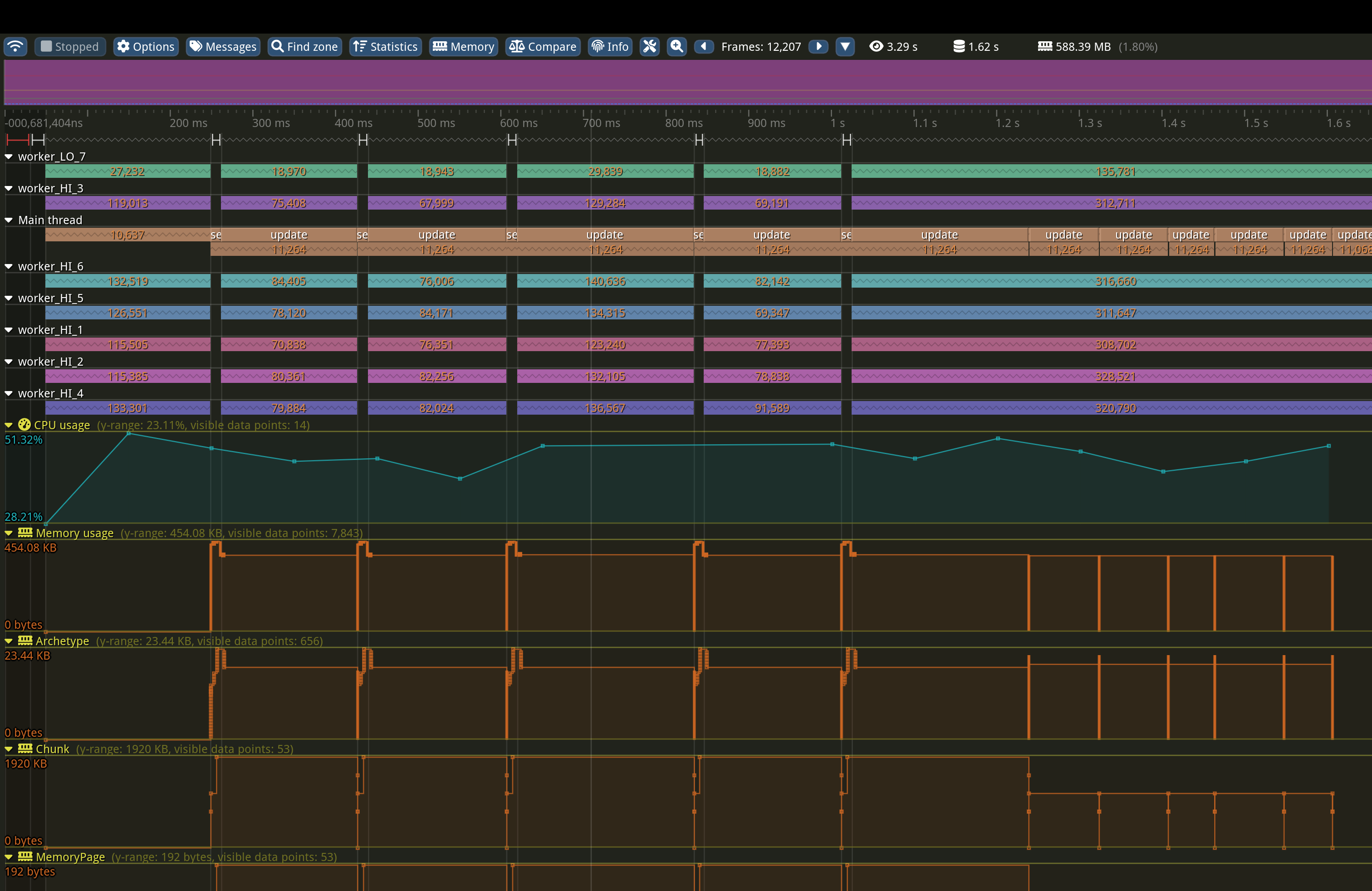
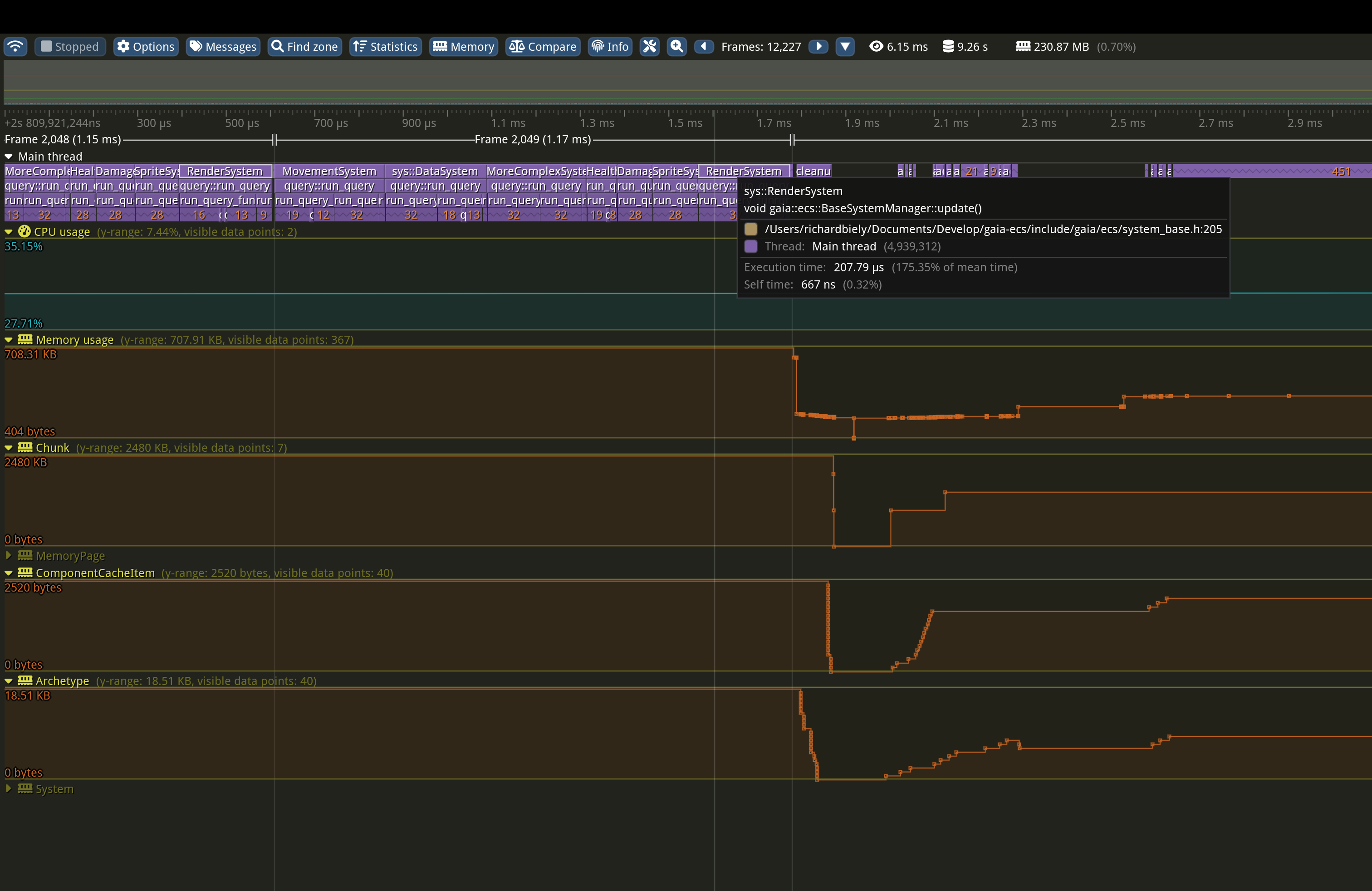
CPU part can be controlled via -DGAIA_PROF_CPU=ON/OFF (OFF by default).
Memory part can be controlled via -DGAIA_PROF_MEM=ON/OFF (OFF by default).
Building the profiler server can be controlled via -DGAIA_PROF_CPU=ON (OFF by default). >NOTE:
This is a low-level feature mostly targeted for maintainers. However, if paired with your own profiler code it can become a very helpful tool.
Custom profiler support can be added by overriding GAIA_PROF_* preprocessor definitions:
The project is thoroughly tested via thousands of unit tests covering essentially every feature of the framework. Benchmarking relies on picobench.
It can be controlled via -DGAIA_BUILD_UNITTEST=ON/OFF (OFF by default).
The documentation is based on doxygen. Building it manualy is controled via -DGAIA_GENERATE_DOCS=ON/OFF (OFF by default).
The API reference is created in HTML format in your_build_directory/docs/html directory.
The lastest version is always available online.
To see what the future holds for this project navigate here
Requests for features, PRs, suggestions, and feedback are highly appreciated.
Make sure to visit the project's discord or the discussions section here on GitHub. If necessary, you can contact me directly either via the e-mail (you can find it on my profile page) or you can visit my X.
If you find the project helpful, do not forget to leave a star. You can also support its development by becoming a sponsor, or making a donation via PayPal.
Thank you for using the project. You rock! :)
Code and documentation Copyright (c) 2021-2026 Richard Biely.
Code released under the MIT license.
 1.9.8
1.9.8